
Macular Degeneration
Macular degeneration is a common eye condition that affects central vision and usually develops gradually. Many people are not aware of the early signs, which is why regular eye examinations are important.
What is Macular Degeneration?
Macular degeneration includes various conditions that affect the macula, which is an area at the back of your eye used for seeing fine details such as reading or recognising faces. As these conditions do not affect your side (peripheral) vision, you will usually still be able to move around independently.
This eye condition most commonly occurs when the macula becomes damaged as you get older. Although it can affect younger people due to genetic conditions, this is far less common than age-related macular degeneration.
Does macular degeneration lead to blindness?
Macular degeneration is one of the leading causes of vision loss in the UK. Although it can significantly affect your central vision, many people with this condition are still able to walk around using their side vision.
However, tasks that rely on fine detail such as reading or recognising faces, may become difficult. Some people may need magnifiers or visual aids to help with daily activities.
What can I do to reduce the risk of age-related macular degeneration?
While age-related macular degeneration cannot always be prevented certain lifestyle choices may reduce the risk of developing the condition or slow its progression such as:
- Quitting smoking can significantly reduce the risk
- Eating oily fish, fruit and vegetables is recommended
- Some supplements such as icaps or macushield may help if advised by your optometrist
- You are at higher risk if someone in your family has macular degeneration
- Obesity and having blue coloured eyes may also be linked to a higher risk
What are the types of macular degeneration
Dry Macular Degeneration
Dry macular degeneration is the more common form of the condition and usually develops slowly. It occurs when yellow deposits build up behind the macula.
Currently, there is no treatment for dry macular degeneration but magnifiers and visual aids may help improve daily function.
Wet Macular Degeneration
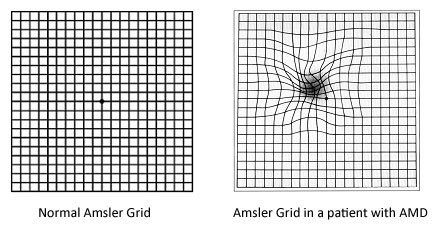
Wet macular degeneration occurs when abnormal blood vessels grow behind the macula and leak fluid. This can cause sudden changes in vision such as straight lines appearing wavy or a blank spot in the centre of your vision.
If detected early, wet macular degeneration can often be treated usually with medication injected into the eye to slow progression.
The Amsler Grid Test
- Hold the chart about 30cm (12 inches) away from you
- Wear reading glasses or contact lenses if you normally use them
- Cover one eye and look directly at the black dot in the centre
- Repeat the test with the other eye
- If lines appear wavy, broken or missing contact your optometrist immediately
When should I seek advice?
If you notice any sudden changes in your vision, including distortion, blurred central vision or difficulty in reading, you should contact your optometrist as soon as possible. Early detection is important for managing macular degeneration effectively.
Concerned about your vision or changes in your sight?
If you are unable to leave home unaccompanied, you may be eligible for a free NHS-funded home eye test carried out by a qualified optometrist.